How to Prepare for CUET 2026 from Class 11: Early Planning Guide
Table of Contents
Introduction
The Common University Entrance Test has fundamentally changed how students gain access to educational opportunities, and as an early start to preparing for CUET, it will be vital in achieving an educational goal of getting into universities such as Delhi University, Jawaharlal Nehru University, and Banaras Hindu University etc. By starting now, while still studying in class 11, you will be placing yourself at a greater advantage compared to students who only prepare for CUET during class 12.
This guide will give you all the information necessary to begin your CUET CLASS 11 Preparations so that you can build a strong foundation, while at the same time balancing board exam preparation. Whether you are preparing yourself or you are the parent of someone who is preparing for CUET, this is an excellent starting point for building a strategy for success in 2026.
CUET and the Importance of CUET
In 2022, the Common University Entrance Test replaced the cut-off-based admission system. The Common University Entrance Test has resulted in establishing a single national standard for admission to all undergraduate programs at 45+ Central Universities and many State and Private Colleges. Additionally, the Central University Entrance System [CUET] is used by over 45 Central Universities and multiple State and Private Colleges to determine eligibility to attend their institutions.
How CUET can impact your Future Success:
- The CUET exam is a single examination that provides access to a variety of courses across multiple universities.
- Merit is the only determinant of your acceptance into college, and not simply your board exam results.
- The CUET provides a standardised means of evaluating students from different boards with respect to exam format, question types, and scoring.
- Students will be subject to one comprehensive exam rather than several tests for each university of interest, thus alleviating the anxiety of numerous university-specific exams.
The CUET consists of three sections:
- Section IA and IB – Language Papers (13 Languages available)
- Section II – Domain-related Subjects (27 Different Subjects Available in Science, Humanities, Commerce)
- Section III – General Test (Reasoning, Numerical Abilities, and General Awareness)
Knowing these sections before Class 11 will allow you to Align Your Studies with the CUET Strategy 2026
Why Starting CUET Prep in Class 11 Matters:
Students who begin CUET Preparation in Class 11 have a higher success rate than students who wait until Class 12.
- More Time for Concept Building
This is due to the fact that class 11 will introduce more advanced concepts that will carry over through the board exams and CUET. If you are using a structured approach for your preparation, you will gain a full understanding of the concepts instead of memorization. Subjects such as Mathematics, Physics, Chemistry, and Economics take time to master; the earlier you start, the greater your likelihood of success.
- Reduced Stress in Class 12
Class 12 has unique academic challenges due to board exams, practical assessments, and project work. Students with a strong foundation from Class 11 should spend time revising and practicing instead of mastering new concepts for the first time.
- Multiple Revision Cycles
Research shows that spacing out your revision has a very positive effect on retention of information over longer periods of time. Since you will be starting Class 11, you will have the time to revise multiple times, something that Class 12 students do not have.
- Flexibility to Experiment
By starting early, you will be able to try many different ways of studying, figure out what your learning style is and adjust your approach accordingly. You will also have the time to figure out which subjects you need to put in extra effort and attention, and which ones come easily to you.
- Better Score Outcomes
The data from CUET 2023 and 2024 indicate that students who prepared for 18 to 24 months had significantly higher percentile scores compared to students who prepared for 6 to 12 months.
| Preparation Duration | Average Percentile | Top University Admissions |
| 6-12 months | 65-75 | 15-20% |
| 12-18 months | 75-85 | 35-45% |
| 18-24 months | 85-95 | 60-75% |
Aligning Board and CUET Syllabus
One of the main advantages of preparing for CUET in Class 11 is the very significant overlap between the syllabus of your Board exams and the CUET syllabus. Smartly preparing for both the Board and CUET exams by capitalizing on this overlap helps you prepare much more efficiently.
Board vs CUET: Understanding the Overlap
| Aspect | Board Exams | CUET | Overlap Percentage |
| Science (PCM/PCB) | Theory + Practicals | MCQ-based concepts | 75-80% |
| Commerce (Accountancy, Business Studies, Economics) | Theory + Numericals | Application-based MCQs | 70-75% |
| Humanities (History, Political Science, Economics) | Descriptive answers | Concept & analytical MCQs | 65-70% |
| Languages | Literature + Grammar | Comprehension + Grammar | 60-65% |
How do you Align Your Preparation Most Effectively?
Step 1: Use NCERT as Your Foundation
The first step to effectively aligning your preparation for both exams is to build your foundation around the NCERT textbooks. Both the Board exam and CUET will heavily utilize the NCERT books, and therefore, you need to be proficient in them chapter-by-chapter.
Step 2: Make Concept Notes
The second step to preparing for CUET 2026 is to develop conceptual notes that will aid you in both examinations. For instance, when learning about “The Kinetic Theory of Gases” in physics, you should note the following:
- Theory and formulas (for boards).
- Key formulas and shortcuts (for CUET MCQs).
- Common misunderstandings and tricky questions.
Step 3: Practice MCQ Format Regularly
The third step involves consistently practicing the MCQ format. Your board exams will require descriptive answers, while CUET will be entirely MCQ-based, so after you’ve finished studying each chapter for board examinations, you should complete 20 to 30 MCQs in relation to that topic to become comfortable with the CUET exam structure.
Step 4: Focus on Application
The fourth step involves focusing on the application. Questions on CUET will test your ability to apply concepts rather than just remember facts. As you study each topic, consider: “How could this be asked as a difficult MCQ?” By thinking of it this way, you’ll be ready for both practical questions for board examinations as well as CUET preparation.
Developing Your Winning CUET Strategy for 2026
To have the best chance of being successful in CUET 2026, you need to create a comprehensive, realistic and personalized plan (CUET Strategy) that will work for you based on your strengths and weaknesses.
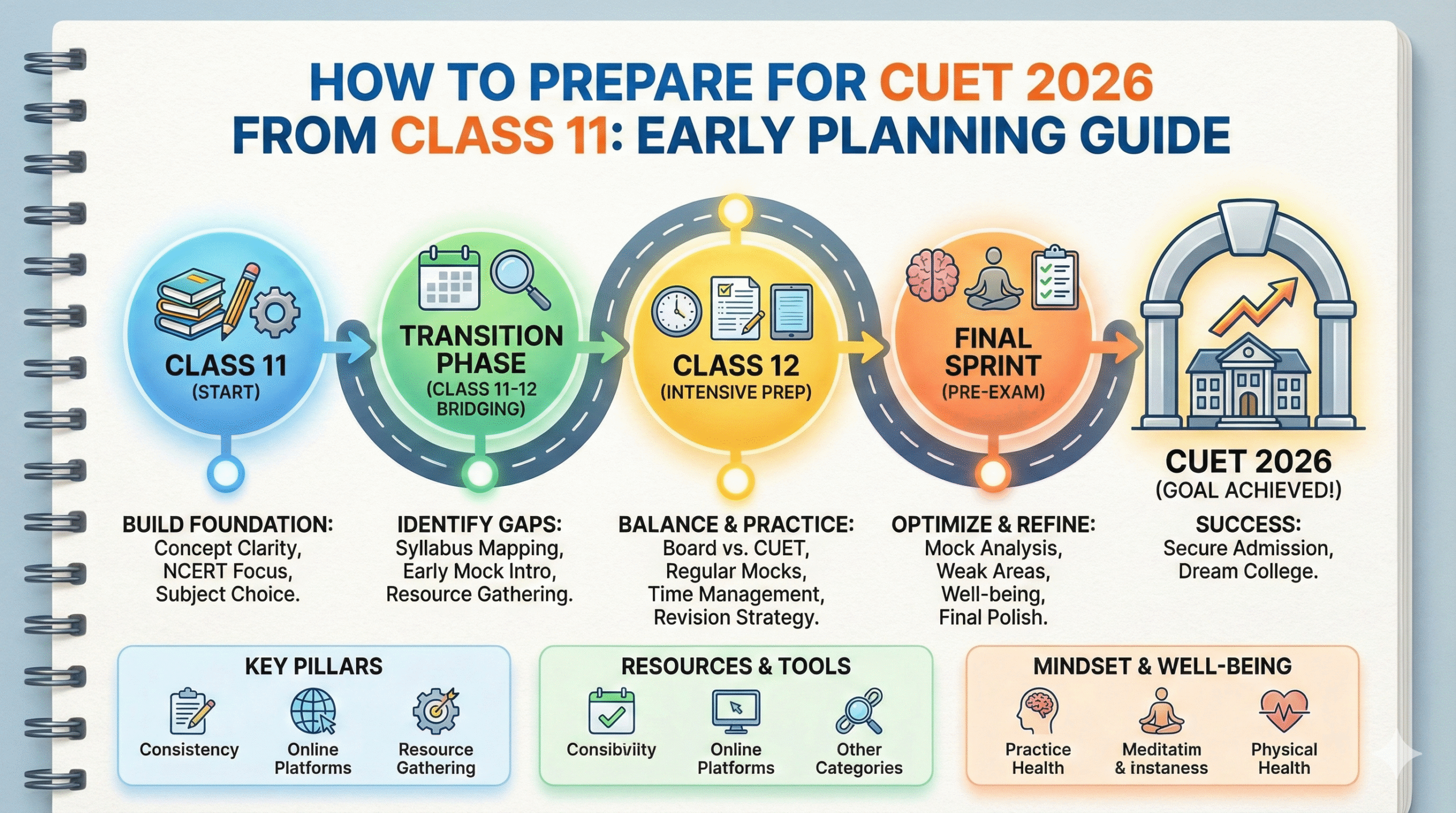
Phase 1: Foundation Building (Class 11, April-December)
Goals:
Phase 1 of the CUET Preparation Strategy will involve building a foundation during the time period of April-December in Class 11. The objectives of this phase are as follows:
- Complete the entire syllabus for both the class 11 board and CUET subjects.
- Establish a solid understanding of the material.
- Create a study schedule and stick to it.
The Daily Schedule for Class 11 students is outlined as follows:
- Combination of School Work / Homework (7-8 Hours)
- CUET Aligned Self-Study (2-3 Hours),
- Revision (30 min),
- Physical Activity / Breaks (1-2h)
Areas of Focus:
- Maths = Algebra, Trigonometry, & Coordinate Geometry
- Physics = Mechanics and Thermodynamics
- Chemistry = Foundations of Physical Chemistry
- Languages = Grammar, Vocabulary development
The goals of this stage (Phase 2) are to:
- Revise the topics taught in Class 11
- Start solving questions from last year’s CUET exam
- Find the areas that need the most attention (or “Weak Areas”)
Activities:
- Take mock tests on a month-to-month basis.
- Complete 50+ MCQs from multiple subjects EVERY DAY ;
- Participate in online forums &/or Study Groups;
- Analyze incorrect answers & Focus revisions on weak areas.
In Phase 3, goals include:
- Complete the Class 12 syllabus
- Integrate the Class 12 & 11 syllabuses
- Prepare for full-length mock tests regularly
Phase 4 Goals:
- More than one revision cycle for Class 12
- at least 15-20 Mock Tests/Series (Full Length) of Class 12
- Time Management (practice how to allocate your time)
- Stress Management (practice how to deal with stress)
Time Management is the Primary Challenge for Students in Class 11 when they start to Prepare Early for the CUET.
The time can be balanced as follows:
Daily Class 11 Study Schedule
Monday – Friday:
- 6:00 AM – 7:00 AM: Morning Review (from the previous day’s Lesson)
- 7:00 AM – 2:00 PM: Schooling
- 2:00 PM – 3:00 PM: Lunch & Rest
- 3:00 PM – 5:00 PM: School work/hw/assignments
- 5:00 PM – 6:00 PM: Physical Activity/ break
- 6:00 PM – 8:30 PM: CUET Study time (new material)
- 8:30 PM – 9:00 PM: Dinner
- 9:00 PM – 10:00 PM: MCQ practice or low-pressure studies.
Weekends:
- Longer study sessions (4-5 hours)
- Mock test practices
- Clearing doubts
- Study topics/chapters in depth
- Engage in non-academic activities
Tips for using your time effectively
1. The Overlap Principle: Study all of the topics that are included in the CUET and the board exams (this will increase your study time by twice).
2. The 80/20 Rule: The majority of your study time (80%) should be spent on the topics that are weighted the highest on the CUET exam. Consult the last year’s question bank to find out what the most popular/higher yield topics are.
3. The Pomodoro Technique: Build your study blocks so that you will study for 25 minutes, then take a 5-minute break, repeat 3 more times, and then take a 15-20 minute break.
4. Weekend Study Patterns: Use Saturdays to learn new things and Sundays for studying and taking practice tests.
5. Focused Study: When studying Physics, do not be tempted to jump to another subject until you complete your study of Physics.
How to Choose CUET Subjects Based on Your Domain
Selecting the right domain subjects for CUET is extremely important and must match your career goals and your strengths.
For Science Students:
- Required Subjects: Physics, Chemistry, Math/Biology.
- Language: English or your preferred language.
- General Tests: Some universities will require Students to take the General Test.
For Commerce Students:
- Required Subjects: Accountancy, Business Studies, Economics.
- Additional Subjects: Math and Computer Science.
- Language: English.
For Humanities Students:
- Choose from: History, Political Science, Sociology, Psychology, Economics, Geography
- Language: English and one additional language
- General Test: Often required
Class 11subject-Wise preparation
Mathematics:
- Master the NCERT thoroughly.
- PRACTICE 10-15problems daily.
- Focus on your speed and accuracy.
- Utilize SHORT CUTS to manage time.
Physics:
- Concepts must be understood before memorizing formulas.
- Create a formula sheet and keep it updated.
- Repeatedly solve numerical problems.
- Associate concepts with real life.
Chemistry:
- Physical Chemistry: focus on numerical problems and formulas.
- Organic Chemistry: practice studying names and associated mechanisms of reactions.
- Inorganic Chemistry: Use mnemonic devices for memorization.
Languages:
- Read something NEW every day, newspapers, books, articles.
- Practice passage comprehension.
- Practice building a vocabulary (ten new words per day).
- Master all grammar rules completely.
Building a Strong Foundation in Class XI
Building a Strong Foundation during class 11 is critical to ACHIEVING SUCCESS in both the Board and CUET.
Concept Mastery Tactics & Strategy
- Learn to attend the class with INTENT, take NOTES, and ask questions.
- Practice: Solve all NCERT exercises and solve additional questions.
- Apply Take MCQ-ways to test/concept-understanding.
- Revise weekly REVIEW of TOPICS completed.
- Test Monthly Self-assessment test.
Essential Resources (Study materials) for your CUET Class XI Preparation
- NCERT textbooks; (XI & XII)
- Previous years’ CUET question papers.
- Subject-specific reference books (RD Sharma Mathematics & HC Verma Physics, etc.).
- CUET resource centre.
Resources for Studying:
- Quick-Fire Review Cards
- Connections Between Concepts Chart
- Reference Formulas
- Logs of Mistakes for Correction
Online Resources:
- Official NTA CUET website for updates
- YouTube channels for concept clarification
- Educational apps for MCQ practice
- Online mock test platforms
How CuetPlus Will Help You
Getting started with your CUET Class 11 preparation may seem like a huge task. But you are not on this journey alone. CuetPlus has been developed specifically to help learners who are preparing to succeed on the CUET test.
What CuetPlus Offers You:
Comprehensive Study Resources: CuetPlus will provide you with curated, exam-oriented materials that match your CUET requirements and Class 11 board syllabus perfectly. Every chapter will prepare you to master a concept in addition to preparing for the CUET MCQ exam format.
Personalized Pathways to Learning: CuetPlus has a personalized Pathway to Learning based on your starting point, target colleges, and available study time. Unlike general coaching programs, you can choose the most challenging areas of either the Sciences or Humanities, and have the Program tailor itself to suit your personal needs, to help you to achieve your greatest potential.
Ongoing Mock and Practice Testing: To understand how much you know and how well you are prepared for CUET, the CuetPlus program provides you with access to chapter-wise, topic-wise, and full-length mock exams, all provide comprehensive analytics that show what your strengths and weaknesses are in your CUET preparation.
Expert Help Resolving Your Doubts: Have you ever been stuck on a tough study topic or question? Then CuetPlus is there for you, as they can connect you to an expert in that subject area to help clarify your understanding and prevent you from falling behind.
Track your progress: You can track your CUET preparation with the help of comprehensive dashboards that detail your strengths and weaknesses and track trends in improvement over time. With the use of data to help guide decisions, you are in a position to make rational decisions about what areas of concentration are appropriate for you.
Through the use of CuetPlus during your Early CUET preparation efforts, you will have access to the methodologies and resources that have helped thousands of students achieve excellent scores on their CUET.
Commonly Made Mistakes – What to Avoid
In life, it is usually beneficial to learn from the mistakes of others. The following are common mistakes Class 11 students are likely to make and how to avoid them:
Mistake 1: Procrastination. Solution: Start now. A commitment of even 30 minutes each day toward your goal is far better than waiting until the “perfect time.”
Mistake 2: Not completing school coursework. Solution: Universities review both CUET scores and board exam percentages when making admission decisions.
Mistake 3: No revision plan. Solution: If you do not revise, you will likely forget. Create a regular schedule for revision on a weekly and monthly basis.
Mistake 4: Studying with no plan or structure. Solution: Random studying will yield random results. Develop a definitive plan of study that is directly related to the CUET syllabus.
Mistake 5: Disregard for physical and mental health. Solution: Exercise, sleep, and taking breaks are all important contributors to effectively utilizing your cognitive abilities.
Mistake 6: Only relying on coaching. Solution: Self-study is essential. Although coaching will enhance your overall preparation efforts, the work must come from you, as well.
Plan of Action and Conclusion
Starting your CUET 2026 preparation in the 11th grade is one of the best choices you can make for your academic future. Having 18–24 months of consistency and dedication will not only allow you to pass the CUET with ease, but it will also create a solid foundation that you will be able to draw upon throughout your whole academic and professional life.
The following is Your Immediate Action Plan
This Week
- Research the universities and courses you would like to attend
- Identify the CUET subjects needed to qualify for your desired program(s)
- Evaluate your current knowledge and level of understanding in each subject
- Download a Dual Syllabus Planner to help you align the topics covered in your Board exams with those tested by the CUET.
For This Month
- Create a detailed 18-month study schedule
- Locate and gather the study materials you will need (NCERT and other reference books)
- Participate in CUET forums and online communities
- Completing a diagnostic exam to assess your starting level of preparation
- Exploring the option to join CuetPlus for guided support.
This Year (11th grade)
- Finish the 11th-grade syllabus while continuing to focus on the fundamentals
- Complete over 5,000 MCQs in each subject
- Take at least 10–15 topic-specific mock exams
- Make sure you have built a solid foundation in the areas where you are having trouble.
- Establish a habit of consistent studying.
Next Year (12th grade)
- Finish the 12th-grade syllabus by the end of December.
- Take at least 20–30 full-length mock exams.
- Take multiple revision cycles on all of the topics in the syllabus.
- Work on developing speed and accuracy.
- Learn how to handle stress during the exam.
It is a good idea to think of your CUET preparation in the 11th grade as a marathon and not a sprint. Establishing a habit of consistency will take you further than simply working intensely on the material in the short term.
Ready to get the most out of CUET? Our dual syllabus planner is free and will help you prepare for your 2026 exam! This unique planner will provide a quick and easy way to identify the requirements needed to successfully pass the CUET. With this resource, you can use your time wisely in your studies by concentrating on one exam at a time.
Download this planner now and take the first step towards a successful future.
Common Questions related to CUET
Is it too early to prepare for CUET in Class 11?
Class 11 is the best time to start preparing for CUET. With about 18 months of preparation time, you will have time to develop good study skills, take multiple revision cycles on each subject, and improve your testing methods. Students who begin studying for CUET while still in Class 11 tend to earn higher scores compared to those who begin in Class 12. By studying the same subjects in both Class 11 (Board) and CUET simultaneously, you will be studying efficiently.
How many hours should a Class 11 student spend each day preparing for CUET?
Class 11 students need to spend between two and three hours a day focusing on preparing for CUET, in addition to their regular homework from school. This would include approximately 1.5 to 2 hours per day on learning new material and approximately 30 to 60 minutes per day of either multiple-choice practice or review. You can devote 4 to 5 hours on weekends, but keep in mind that regularity is key when it comes to studying, so try to maintain a schedule that is consistent and focused. Quality over quantity is the most important factor in the effectiveness of your study sessions.
Is it possible to be adequately prepared for CUET without any coaching if I’m starting preparation early (in class 11)?
Yes! There are many students who get through CUET by preparing on their own without any coaching. The key is to start preparing that early. Students can prepare on their own by using various resources, such as NCERT textbooks, previous year papers, and the Internet (including online solutions and YouTube videos), which will help them. While some students may prefer a structured course of study with coaching or online programs that provide guidelines, assistance in resolving doubts, and a means of assessment, many students choose to prepare on their own based on their own study habits and the level of discipline they enjoy with their current studies.
Which subjects should I take for CUET in class 11?
When selecting your subjects for CUET, you should consider your stream and chosen university/course. Students taking Science generally take subjects such as Physics, Chemistry, Maths, or Biology. Students taking Commerce generally take subjects such as Accountancy, Business Studies, and Economics. Students taking Humanities may choose any combination of History, Political Science, Economics, Psychology, Sociology, or Geography. It is important to investigate your target universities’ requirements no later than the start of your studies in class 11, so you will know what subjects to choose. Most students take 3-4 domain subjects plus 1 language subject.
Do marks received during Class 11 play an important role in determining admission at CUET?
Yes, while Class 11 marks are not part of your admission calculation, they are essential to establishing a strong foundation for success during the CUET test. Your final admission at a university will depend primarily upon your CUET score, combined with your Class 12 Board exam score(s). However, it is important to realise that many of the concepts tested on CUET will relate back to what you have learned in Class 11 – approximately 40%-50%. Generally speaking, if you perform poorly during Class 11, you will experience difficulties with fundamental concepts needed to perform well on the CUET. Therefore, instead of concentrating on collecting as many Class 11 marks as possible, you must focus on truly understanding the material presented in Class 11.
What are some of the main differences between the CUET exam and Board Exams?
The CUET and Board exams differ in multiple ways: (1) Format – CUET only consists of multiple-choice questions (MCQs) while Board Exam(s) consist of descriptive answer(s); (2) Syllabus – CUET will be covering both Class 11 and Class 12 together while Board Exam(s) will only test one class at a time; (3) Difficulty Level – CUET exam questions will require application and analytical skills while most Board exam questions focus on recall ability; (4) Time Limitations – CUET has strict timings, meaning you will need both speed and accuracy to complete all questions; (5) Negative Marking Option – There is negative marking for incorrect answers on CUET while there was no negative marking on Board exams; However there is approximately a 70%-80% overlap in the syllabus between CUET and Board Exam(s).
How many times should I practice mock tests in Class 11?
During Class 11, you should focus on doing a Chapter-Wise and Topic-Wise test. After studying each chapter, you should do 1-2 topic tests per week. For Chapter Tests, do one Full-Length Mock Test at the end of each term (so around 4-5 Full-Length Tests during Class 11). Intensive practice for Mock Tests will be saved for Class 12 — 20-30. Full-length mock Tests will be done in Class 12. In Class 11, you are working to create and understand a conceptual base and becoming comfortable with the MCQ format, not preparing for a Mock Test Marathon.
If the syllabus outlined in my Board and CUET does not match up completely, what should I do?
The two syllabi overlap by about 70 to 80%, leaving the potential for some topics to be different. Therefore, it is important to schedule additional study time for the topics that appear in the CUET but do not appear in your Board syllabus. Furthermore, after checking the CUET syllabus documents available on the NTA website, identify any gaps you may have been exposed to as soon as possible. Generally, a majority of the extra topics that will be included in the CUET will take approximately two to three months if started in Class 11. Students taking the Class 12 exam with CBSE boards will find that their exam syllabi overlap the most, while Students taking the state board exam will likely find that they need to learn a few extra topics. Prepare a Gap Analysis Chart to methodically identify the differences between the two syllabi.
How important is the General Test section of the CUET?
Depending on the university and programme you want to attend, the General Test section of the CUET may or may not be very important to your admission process at that university. Research your target universities early on to determine their admission requirements as far as the General Test section is concerned. The General Test section assesses reasoning (logical), reasoning (Quantitative), and general awareness- skills that are developed over time through consistent practice. If you have identified your target programmes as requiring the General Test, take the time to prepare yourself by practicing for at least 30-45 minutes a day starting from Class 11. A gradual approach will help ensure that all of your preparation is complete before your final examination and that you will not be cramming in the days before the examination.