
CUET 2026 Exam Day Guide: Dos, Don’ts & Checklist for Success
The CUET (Common University Entrance Test) is one of the most significant entrance exams in India because it offers students access to some of the best central universities in India. So, as your CUET exam date approaches, be mindful that preparing for your CUET examination involves more than just studying. Knowing what you need to do and avoid as well as what items to take with you can greatly assist you with the performance and confidence during your CUET examination.
The CUET Exam Day tips by CuetPlus have gathered together all the relevant information on your CUET exam day, making it easier for you to prepare. The tips in this guide will help you avoid any confusion and ensure that you are prepared to take your CUET exam, regardless of whether you are taking the exam for the first time or are retaking the exam.
Table of Contents

Understanding CUET Exam Day Logistics
Before getting into the detailed information about CUET exam day suggestions, it is important to have an understanding of the workflow of the exam. The CUET Exam will occur across several testing centres around India and will be administered by the National Testing Agency (NTA). The CUET Exam is a computer-based examination and, as such, is conducted in multiple sessions to allow for the expected volume of candidates.
The following are the primary features of the CUET exam:
- Mode of Exam: Computer-Based Test (CBT)
- Length of Time to Complete Test: Will vary based upon subjects selected (typically, the time allotted to each section is 45 minutes)
- Arrival Time: Required to check in to the testing centre at least two (2) hours before the scheduled test date and time
- Last possible check-in: 30 minutes before the scheduled test date and time
- Type of Questions: Multiple Choice Questions (MCQ)
Familiarising yourself with these logistical features will enable you to better prepare for your exam day so that, if there are any unforeseen circumstances, you will be able to respond to them without panic.
Complete CUET Exam Checklist: What to Bring
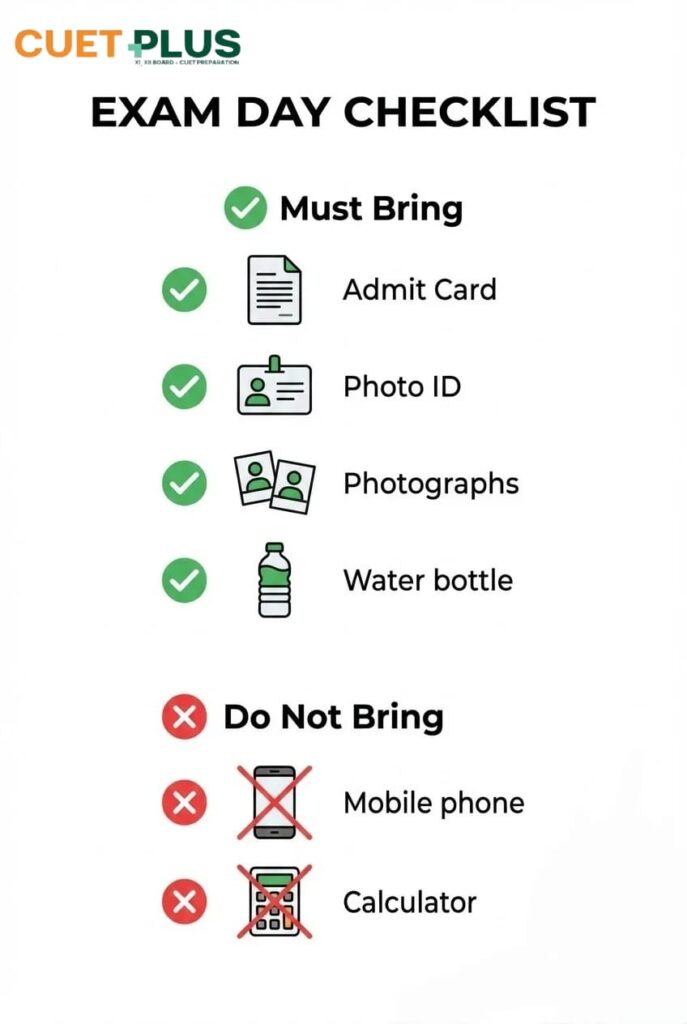
To ensure success on exam day, compiling a thorough CUET Preparation List is the initial step in the examination process. Be sure to help prepare for the day of the exam by taking the following things with you to the exam:
Main Documents Required (Items You Must Bring)
1. CUET Exam Card
The CUET Examination Card is an important document that allows you access to the exam hall. If you do not have this document, you will be unable to take the exam, regardless of circumstances.
- You should print out two or three copies of your CUET Exam Card.
- You need to ensure your photo and signature are each clearly visible.
- Please verify the following: your name, roll number, and exam location are all correct.
- Store one copy in your bag and one copy in your pants.
Tip: You can keep a digital version of your CUET Exam Card on your phone as a second copy; however, you must carry a printed version as well.
2. Proof of Photo ID Identity
You are required to carry one of the original items listed below that will prove your identity:
- Aadhaar Card (with picture of you)
- Passport
- Driver’s License
- Voter Identification Card
- PAN Card (with picture of you)
- Bank Passbook (with picture of you)
- School/College Identification Card (with picture of you)
Please note: Copies of your identification document (photocopy/scanned) do not meet the requirement. The name on the form of identification must match exactly as on the CUET exam card.
3. Recent Passport-Size Pictures
Bring with you 3-4 of the most recent passport-sized photographs that you submitted with your registration process for any future verification that may be necessary, and protect these items with a folder to ensure they will not become damaged.
Stationery Items – Allowed
The majority of the materials needed can be found at the testing centre; however, we do suggest you bring with you the following items:
- Transparent Water Bottle – Stay hydrated while taking the exam; please make sure the water bottle is transparent and does not have any labels on it.
- Personal Hand Sanitizer – Small, transparent bottle (if permitted by current regulations).
NOTE: The use of pens, pencils, erasers, calculators, and rough sheets will typically not be allowed, as candidates will perform most of their rough calculations on the computer screen or on rough sheets supplied by the testing centre.
Medical Personal Items
- Prescribed medications – If a candidate has a medical condition that requires medication,n they should bring their prescribed medication to the exam with their doctor’s prescription.
- Glucose Tablets/Candy – For a quick energy boost, is permitted (check with your testing centre for their specific regulations).
- Spectacles – Bring spare spectacles, if you wear them, in case your regular pair gets lost.
- Face Masks – All exam candidates should have one at all times, even though there may currently be no requirement to wear one.
What You Should Leave at Home (Prohibited Items)
You should not carry the following items with you when you go to take your exam,m as they will cause issues for both you and the exam centre:
- Mobile Phones / Smart Phones / Communication Devices
- Smart Watches / Digital Watches with Memory
- Calculators / Electronic Devices
- Books / Notes / Study Materials
- Bags and Cases, except for small Transparent Bags for Essential Items
- Jewelry & Metal Accessories
- Food Items, unless required for Health Reasons (with supporting documentation)
- Bluetooth Devices / Headphones
- Camera / Recording Devices
- Wallets that contain any Metal Components
Important Advisory: Exam Centres typically do not store prohibited items. As a result, if you take a prohibited item(s) into the exam centre, you may experience delays or, in some cases, not be allowed to enter.
CUET Dos and Don’ts: Essential Guidelines
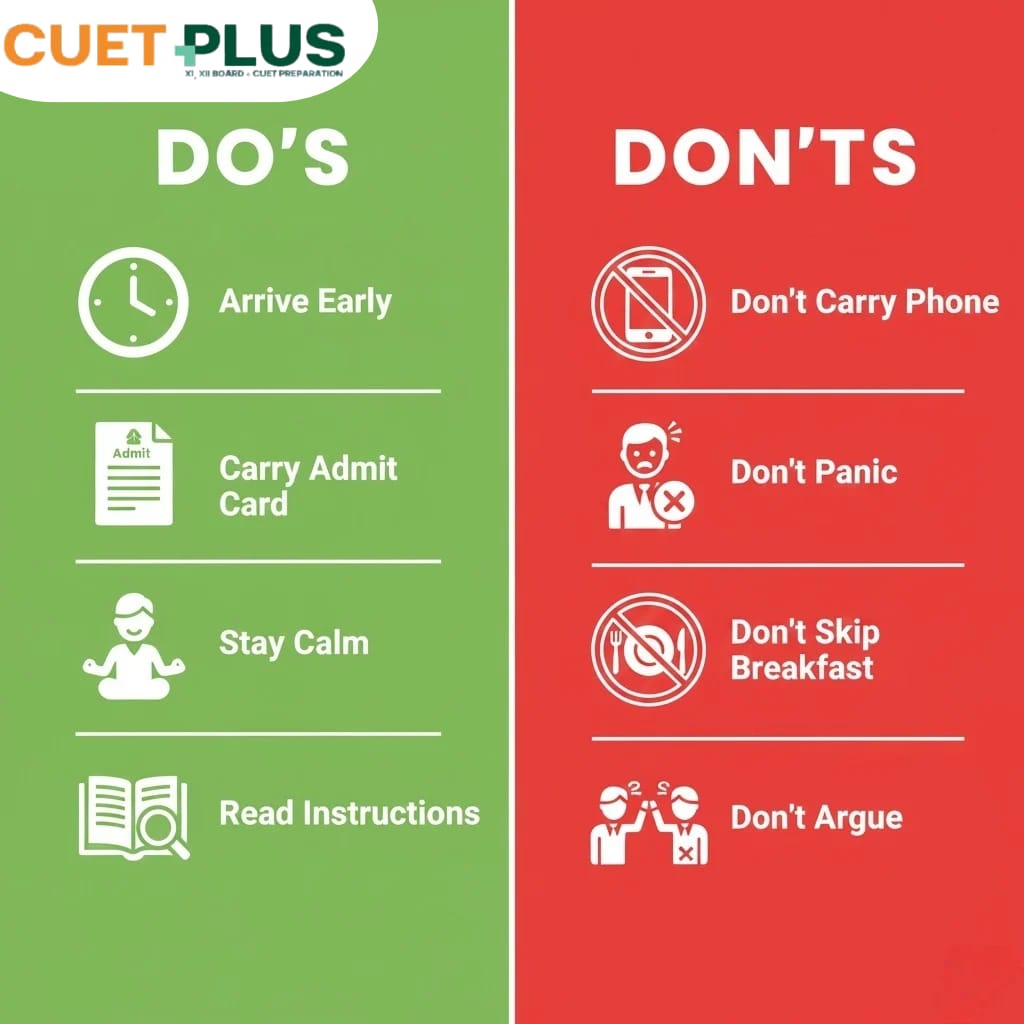
CUET dos and don’ts will help ease anxiety and provide you with an experience of success on your test day. As you begin preparing for CUET, use these tips as a resource:
Important Items To Remember Before Leaving Your Home on the Day of Your CUET
1. Get Up Early: Set several alarms at least three to four hours before your CUET start time. So that you can allow extra time for unforeseen delays.
2. Eat a Healthy Breakfast: Eating a healthy breakfast will help give you enough energy throughout the day. The ideal meal should contain protein and whole-grain carbohydrates to keep your metabolism going strong.
3. Recheck Your Checklist: Don’t forget to recheck the CUET Exam Checklist one last time before you leave.
4. Wear Comfortable Clothing: Wear clothes that fit comfortably and can easily be layered over as needed. Stay away from metal zippers or any type of accessory that could cause distractions.
5. Know What The Weather Will Be: Be aware of any potential bad weather or extreme heat/coldness and dress accordingly.
At the Exam Center:
1. Allow ample time to arrive at the Exam Center (90-120 minutes prior) before the scheduled exam time.
2. Please listen closely to all announcements and instructions from the exam administrator
3. Read all the screens in full before beginning the examination
4. Monitor your time throughout the exam. Record how much time has elapsed for each of the sections and each question
5. Stay calm—if you feel anxious or ill-prepared, take some slow, deep breaths
6. The Mock Examination provided may help you become accustomed to the look and feel of the computer format before actually taking the exam.
7. Check that your information on the computer screen is correct, including your name, photo, and other identifying information
8. Use the restroom during breaks or before entering the exam room.
During the Examination:
1. Read all questions carefully before answering. Take your time and make sure that you understand what you are being asked.
2. Answer the easiest questions first. Doing so will help build your confidence to tackle the more challenging questions.
3. If the program allows you to mark for later review, use this feature to “bookmark” questions that you want to come back to later.
4. If you struggle with a question, use the process of elimination to see if you can narrow down the answer to two or three possibilities. Then determine which one of the possibilities is the most reasonable.
5. Pay attention to the timer for each section.
6. Maintain focus on your exam and avoid distractions from other candidates.
Critical Don’ts for CUET Exam Day
Before the Exam:
- Avoid learning anything new within 24 hours of taking your exam.
- Please eat breakfast before your ex. You should never go into an exam on an empty stomach.
- If you enter the test late, take a deep breath and contact the helpline number printed on your exam admission ticket.
- You will perform better in your exam if you sleep the night before your test rather than staying up all night.
- Never take any new medicated supplements or products before testing/whatever day your testingl on.
At the Center:
- Work cooperatively with your proctor(s); they are there to help you be successful.
- Bringing any items to this exam that are prohibited can cause your test to be cancelled; do not bring anything on the list that is not allowed.
- You cannot communicate with anyone else taking the exam, even if it is about the answers to the questions.
- You should take great care of the building, equipment, and surrounding areas of the exam; do not damage them in any way.
- Stay until the proctor dismisses you from the exam, regardless of when you finish.
During the Exam:
- Rushing through an exam can cause you to miss mistakes you may make.
- If a question seems challenging, skip it and come back later after you have answered all other questions.
- You will not lose any points for unanswered questions (due tothe current exam format), so take a chance on the ones you don’t know.
- You should trust your gut feeling when answering questions; if you aren’t sure, don’t doubt yourself too much.
- If you experience any technical difficulties during the exam, immediately raise your hand.
Time Management Strategies During the Exam
Time-management is essential to accomplish your highest potential score for the CUET examination. Here are the recommended approaches for doing so:
Time Management by Section
Generally, each section of the CUET examination consists of 45 – 60 minutes of testing. The following illustrates how to allocate your time accordingly:
The Planning Phase (First 5 Minutes):
- Perform a quick overview of the examination to assess the difficulty level of each question.
- Determine which questions are easy, moderate, and difficult.
- Formulate a plan for answering the questions.
The Execution Phase (Next 30 – 40 Minutes):
- Start with the questions that you feel most comfortable answering.
- Aim to complete 60 – 70% of the total number of questions in this phase.
- Utilize the “Mark for Review” option once you have completed the above.
- Do not spend more than 60 -90 seconds on any single question initially.
The Review Phase (Last 10 – 15 Minutes):
- Attempt the questions that you marked for review during the above phases.
- Review any flagged (marked) answers for possible correction.
- Confirm that you have answered all the questions that you intended to answer.
- Recheck that you did not miss any of the sections of the examination.
CUET Time Management Formula
The total time you have to answer a section of 50 questions is 45 minutes. The breakdown is as follows:
- Easy Questions (20-25 Questions): 30-45 seconds each
- Moderate Questions (15-20 Questions): 60-90 seconds each
- Difficult Questions (10-15 Questions): 2-3 minutes each
- Review Time: 5-7 minutes
Smart Ways to Manage Your Time Better
1. The Two-Pass Method:
- First, do all the easy and moderate questions.
- Then, do the hard questions and any that you have marked for review.
2. Strategic Guessing:
- If you can eliminate at least 2 or 3 answers, make an educated guess.
- Do not leave a question unanswered (if there are no penalties for guessing).
3. The On-Screen Calculator:
- For math problems, make the most efficient use of available resources.
- Practice using the on-screen calculator during mock tests before taking the real exam.
4. Do Not Be a Perfectionist:
- Do not spend too much time trying to be 100% sure of the answer.
- If you have thought about a question reasonably well, keep going forward.
5. Section Navigation:
- Utilize the section tabs to move from one question to another.
- Write down which questions have not been attempted by marking them on the question palette.
Stress Management Tips for Exam Day
While it is normal to have some anxiety surrounding exams, it is also important to understand that when stress is excessive, it will negatively impact your performance on the exam. Here are a few ways to reduce stress throughout the day of your CUET Exam.
How to Reduce Stress Before the Exam
1. Visualize Yourself Performing Well
- Close your eyes and imagine you are successfully answering all the questions.
- See yourself obtaining the results that you want.
2. Utilize Deep Breathing Techniques
- Use the 4-7-8 technique for breathing. Breathe in for 4 seconds, hold for 7 seconds,s and breathe out for 8 seconds.
- Repeat this 3-4 times each time you feel anxious before or during the exam.
- Continue to use deep breathing while waiting at the Exam Centre.
3. Use Progressive Muscle Relaxation Techniques
- Tension and release different muscle groups (i.e., from your toes all the way up to your head) to release any tension stemming from the stress you are feeling.
4. Use Positive Affirmations
- Say to yourself,f “I am ready for this ex.”
- “I can answer any questions that come. up”
- “I have absolute faith that I have prepared appropriately, and I know I am capable.”
Managing Exam Stress
Feeling Overwhelmed?
1. Short Break:
- Closed Eyes for 10-15 Seconds
- Three Deep Breaths
- Refocus Eyes to Current Question
2. Refocus Your Perspective:
- “Difficult question does not mean my entire exam questions will be hard.”
- “Do not expect to do all questions perfectly.”
- “I will answer all questions to achieve the highest score possible, not a perfect score.”
3. Physical Techniques:
- Tension Release by Shoulder Rolling
- Neck Stretching
- Finger and Toe Wiggling to Increase Blood Flow
4. Mentally Reframe Thoughts to:
- “Instead of saying ‘I cannot do this,’ say ‘I will do my best to answer all questions with the facts and skills I have to answer them.'”
- “Difficult questions are challenges, NOT threats.”
- “Remember why you got here; refer back to your preparation journey.”
How to Handle Tech Problems
Technical Problems are Frustrating. Here’s How to Deal With Them:
- Cool Heads Prevail; Stress Will NOT Help.
- Notification of Tech Issues to Invigilator: Raise Your Hand Immediately.
- Never Touch Anything; Wait for Tech Support.
- Record Time Lost; most times will subtract Time Lost
- When Started Again, use Breath and Confidence to Move On.
Last-Minute Troubleshooting Guide
While we may need to be prepared for anything, there are ways we can deal with common problems that occur during the CUET exam day.
Problem 1: You forgot your Admit Card
Solution:
- Check to see if there is a digital copy of your Admit Card stored on your mobile device; if so, you can show that to the invigilators.
- If you don’t have this with you, immediately contact the NTA helpline and inform them of your situation.
- You may be admitted to some centres with proper identification and verification of your identity.
- In the worst-case scenario, download your Admit Card from online and print it at a local shop.
Problem 2: There is a name mismatch between documents
Solutions:
- Bring any supporting documents (such as school certificates) to prove your identity and name.
- Speak to the Centre Superintendent as soon as you arrive.
- Explain your situation calmly and respectfully, using evidence to support your position.
- You may need to document the issue in writing, if necessary.
Problem 3: You are running late
Solution:
- Don’t panic, it will only affect your ability to drive and travel safely.
- If you can contact the exam venue, please do so to let them know about your delay.
- You should take the safest and fastest route to reach the venue. When you arrive, explain your reason for being late to the invigilators.
- It is usually possible to enter the venue within thirty minutes before the examination starts.
Problem 4: Feeling unwell
Solutions:
- If you feel unwell, tell the invigilator as soon as possible.
- If you take medication for your illness, please do so.
- If you need to go to the toilet, let the invigilator know so they may allow you to do this immediately. If you are seriously ill, you may need to request additional time, submit a doctor’s note, and reschedule the exam.
- In addition to the above, you should also consider whether you can continue taking the examination.
Problem 5: Technical Malfunction with the Computer
Solution:
- Raise your hand for immediate assistance
- Do not attempt to fix the problem by yourself
- Wait for help to arrive. Your exam clock will be adjusted for the time that the computer was malfunctioning
- Stay calm, it is in the system, and will be resolved
Problem 6: I Forgot My ID
Solution:
- Look thoroughly for ID—there may be one in another pocket
- Maybe some other acceptable ID
- Call the Chief Credentialing Officer. Bring other supporting forms of ID, as requested
- Worst case will have to reschedule, depending on NTA policy.
Post-Exam Steps
Your exam day (CUET) does not conclude when you submit your responses; here are some important steps to take after taking your exam:
Immediate Actions Taken After Taking the Exam
1. Collect Your Belongings
- Do not leave anything behind at the exam centre.
- Ensure you check all of your pockets as well as the area around your seat.
2. Record Your Experience
- If anything unusual happened, make sure you are documenting it.
- Record any issues with the conditions of the exam centre.
- Remember your session/shifts.
3. No Discussion of Your Exam After Your Exam Is Complete
- Do not talk to others who took the exam about their answers as soon as you have completed the exam.
- It may lead to unnecessary anxiety and doubt.
- Concentrate on recovering and getting back to normal after taking your exam.
What to Do Within 24-48 Hours After Taking Your Exam
1. Review the Answer Key
- Review of the answer key is typically released by NTA.
- You should compare answers based on where you recall your answers.
- Based on the comparison of your answers to the Answer Key, you should estimate your score.
2. File Objection If Necessary
- If you believe there is an error in the answer key, file an objection with the NTA per the procedures outlined by them.
- A proper justification and fee (if needed) must be included with the filed objection to the NTA.
3. Be Good to Yourself
- Get plenty of sleep and rest.
- Eat a healthy, well-balanced diet.
- Engage in stress-relieving or calming activities.
- Reduce time spent on devices (screen).
Looking Ahead:
1. Download Your Response Sheet:
- Download from the NTA website once it becomes available
- Use to check marked answers
- Save for future reference
2. Prepare to Receive Your Results:
- Mark on your calendar when the results are due to be released
- Prepare any documents you may need for the counselling process
- Research colleges and their programmes based on expected scores
3. Stay Informed:
- Follow CuetPlus (https://www.cuet.plus/) to stay up-to-date with current events
- Keep monitoring the NTA official website
- Join student forums and social media groups
4. Make Plans for Counselling:
- Familiarize yourself with the CSAS counselling process
- Create your list of preferred colleges/programmes
- Gather all supporting documentation for verification during counseling
Final Words: Your Success Mantra
Success on CUET Exam Day Requires a Combination of Preparation, Strategy, and Mindset. You Have Worked Hard in Preparation and Now It Is The Time to Trust Your Preparation
The Following Key Items Are Included in The CUET Exam Day Guide:
- For A Smooth Experience, Use The Comprehensive CUET Exam Day Checklist To Make Sure You Have Everything You Need
- Follow The CUET Do’s And Don’ts To Have A Smooth Transition On The Day Of The Exam
- Use Time Management Strategies During The Exam. Practice Stress Management Techniques So That You Can Remain Calm. Know How To Handle Unforeseen Circumstances
- Concentrate On Your Performance Rather Than Perfection
Keep In Mind That The CUET Exam Is Only One Of Many Steps That Will Help You Achieve Your Educational Goals. Do Your Best, Be Positive And Believe In Your Preparation. Every Year Thousands Of Students Successfully Complete The CUET Exam And You Can Too.
Download Your CUET Exam Day Checklist
Are you ready to secure first place on the CUET 2026?
To help you get started, CuetPlus has created an easy-to-use web page at https://www.cuet.plus/, which provides access to:
- A downloadable CUET exam day checklist (in PDF format)
- The most recent CUET exam updates and notifications
- A range of information and guidance concerning the CUET examination admit card
- Specific information and recommendations regarding the CUET exam centre where you will be taking the CUET exam, including maps, directions, and parking information
- All the tools you will need to prepare for the CUET exam, along with many great last-minute tips to help you perform your best on exam day
- Once you have completed the CUET examination, you can receive assistance through CuetPlus’ post-CUET counselling support.
Don’t leave your success to chance—go to https://www.cuet.plus/ now, and download your complete checklist for the CUET examination day, so that you are 100% prepared for CUET 2026.
Disclaimer: It is important to note that these tips provide general examples of CUET examination patterns, along with the guidelines of the National Testing Agency (NTA). Always use the CUET examination admission card you received and the NTA’s notifications to determine any information specific to your CUET examination session.
CuetPlus is the most reliable source of information to assist you in preparing for your CUET’s, as it provides a valuable compilation of resources, including expert guidance and continuous guidance through real-time updates throughout your CUET journey (Common University Entrance Test). To learn more about CuetPlus, please go to https://www.cuet.plus/.
FAQs About CUET Exam Day
What happens if I absentmindedly leave my admission card at home on the day of my test?
If you do not have your admission card, don’t sweat it; however, first see if you have a digitized admission card in your phone. Note: that a physical version of the ticket is required. If you are still home or near home, head straight back to your home to retrieve it. If you are already at the examination center, let the examination supervisor know immediately. Some exam centers may allow students to download and print their admit cards via a local print shop based on time-lot; however, if you arrive without an admission card, you will most likely be denied access to the examination room; therefore, be sure to double-check for your card before leaving your home to go to the examination center. We recommend you keep 2 to 3 hard copies of your admission card. In addition to this card, we have created an exam preparation checklist on our CuetPlus site to help you prevent this situation from happening.
Is it permissible to bring my cell phone to the testing location if I keep it off?
It is not permissible to bring your mobile device to the test site, CUET test site, even if it were kept powered off. All cell phones and any type of electronic communication devices are prohibited; most testing locations do not provide a secure storage area for personal items, and entering the testing site with prohibited materials could result in severe penalties, including the cancellation of the exam. The best option would be to leave your phone at home or give it to someone who can stay outside while you take the exam. Only take the items listed on your admit card and the CUET guidelines describing what you should and should not bring.
For the CUET exam, how early should I plan on arriving at my exam centre? If there is heavy traffic and I will be arriving late, what should I do?
It is recommended to arrive at least 90-120 minutes (1.5-2 hours) before your scheduled CUET examination. This will allow plenty of time for security clearance, to complete biometric authentication,n and to find your desk/sit down. If you will be arriving late due to an avoidable situation, such as a breakdown or prolonged road time, attempt to follow the safest route possible and remain calm. Gates close approximately 30 minutes before your examination time, so if possible, let the centre know you are arriving late and provide justification upon arrival. Be sure to have provided documentation of the reasons for your late arrival. It is best to plan your route the day prior and leave your home very early.
If my computer freezes or malfunctions during my exam, what do I do?
If your computer freezes or crashes, or you are unable to connect to the system while taking your CUET test, raise your hand immediately to get the attention of the test supervisor. Do not attempt to fix the issue on your own or randomly press keys. Please be patient while the technical support staff resolves the issue. Your exam timer will be adjusted or placed on hold to account for the time you lost as a result of the technical difficulties experienced. All incidents of this nature are recorded by the system, and you will not be penalized for them. This is why it is very important to remain calm during a situation that comes up unexpectedly on the day of your CUET exam as part of managing your stress. Backup mechanisms will be in place within the system to enable the retrieval of responses before a student experiences an issue.
Does CUET have negative marking? If yes, do I have to answer all questions, even if I’m not sure of the answers?

The negative marking policy in CUET differs from section to section and from year to year; therefore, it is important to refer to the particular pattern of your examination indicated on the official CUET notification for 2026. In the Historic sense, there has been no negative marking for CUET; thus, it would be prudent to attempt every question, regardless of how certain you may be of an answer, because leaving questions unanswered only decreases your chances of earning a higher score. However, should there be a negative marking component included in your exam pattern, you can use the elimination method to find the best option. Also, outline a time management strategy throughout the exam. Start with the items you feel most confident about, then work down the list to the more challenging items. To find the most current pattern changes for CUET 2026, as well as any updates to CUET 2026’s Section-based Point System, you can go to CuetPlus at https://www.cuet.plus/.