
Time Management for CUET 2026: Weekly Planners & Study Hacks That Really Work
Table of Contents
Now, let me be straightforward with you: the main reason students fail CUET isn’t because they are not smart enough; it is because they study like they are lost in woods without a map. They jump from one chapter to another. They study whenever they feel like it. They promise themselves they’ll “catch up later.” Then later never comes. Best CUET time management with proven weekly planners, study hacks & expert tips. Ace your prep with structured schedules, mock test strategies & practical study techniques from CUETPlus
I have seen students achieve fantastic CUET scores. Not the ones who had the most time, not the ones at the fanciest coaching centers, but the ones who had a plan and actually stuck to it. That’s the whole difference.
If you are feeling overwhelmed now-like there’s too much to study and not enough time-believe me, you are not alone. Every single CUET aspirant feels this way. But here comes the good news: Time management is actually a skill you can learn. And I’m going to teach you exactly how.
Why CUET Time Management Is Your Secret Weapon (And Most Students Don’t Get It)
CUET is brutal. You go up against over 10 lakh students in this country. Some are studying full-time. Some are doing school, boards, and CUET prep together. Some started prep since a year ago. Some just started since last month.
In this chaos, time becomes your most valued asset. More than money, more than coaching and more than luck.
Here is what happens to students who do not have a plan:
They spend hours studying their favorite subject because it feels good. Then, they ignore weak areas because they are painful. They do a random chapter from the book because it’s there. They watch YouTube videos and call it studying. They get to two months before the exam and realize they haven’t even started revision or mocks.
Then panic. Then last-minute cramming. Then disappointing results.
But here’s what happens when you have a solid time management system: You know exactly what you’re studying today, why you’re studying it, and how it fits into your big picture. You balance all sections equally. You leave enough time for revision and mocks. You feel in control instead of rushed. And most importantly, you actually see results.
Start Here: Steps for Cuet Prep Time management
Before opening any planner or making any plan, you need to be brutally honest about your situation.
Step 1: Map Your Fixed Hours
Take a piece of paper, or open a note on your phone. Write:
- School/college hours (including commute)
- Coaching classes, if any
- Sleep-you need 7 to 8 hours, no excuses
- Meals
- Any other non-negotiable commitments: family duties, part-time job, sports, etc.
Be honest. Do not write down fantasy hours, write down what actually happens.
Let’s say you’re in school. Your day would look roughly like this:
- Sleep: 8 hrs
- School + commute: 7 hrs
- Meals + random stuff: 2 hours
- That leaves you with: 7 hours of flexible time
Out of those 7 hours, maybe 1 hour goes to relaxation, family time, or social life-you need this, trust me. That leaves you with 6 hours of actual self-study time.
This is your real number. Not the 10 hours you dream about. The 6 hours that’s actually realistic.
Step 2: Understand What You’re Preparing For
Next, visit the CUETPLUS Syllabus page and read in detail the entire syllabus for the following:
- Your target language
- Your domain subjects
- The General Test
Now, don’t just scan it. Write it down. Get a feel for how much there actually is.
Then be honest about which topics scare you. Which ones do you already know? Which ones are completely new? Which ones have you studied before but forgotten?
This is not about perfection, but it’s about being real with one’s self. Because your plan needs to be built on reality, not fantasy.
Step 3: Know Your Target
Are you going for a BBA? B.Com? BA with History? Hotel Management? Different programs mean different priorities.
For economics, you have to crush it; for BMS, business studies gets more time. Your plan should reflect what you’re actually going to do, not some generic plan that you copied off the Internet.
To discuss your target in particular and how to set up your study plan towards your target, visit CUETPLUS Coaching for consultation with mentors.
Best CUET Time Management with Weekly Study Planners: Where Everything Actually Happens
The monthly plans are nice for the big picture, sure. But honestly? The magic is in the weekly planners.
Here’s why: A monthly plan says, “Study economics this month.” The weekly plan says, “Finish unit 1 of economics, do 30 practice questions, and review unit 2 from last month by Friday.”
The weekly plan seems realistic, while the monthly plan is too general.
How to build your first weekly planner.
Step 1: Determine Your Actual Study Hours
Take those 6 realistic hours we calculated earlier. Now decide how to split those:
- English: 1.5 hours
- Domain Subject 1: 2 hours
- Domain Topic 2: 1.5 hours
- General Test: 1 hour
These are just examples. Your split depends on what you’re targeting. If you are weak in Math, give quant more time. If you are already good at English, maybe spend less on it.
Step 2: Create Daily Blocks
Instead of just saying “study English,” make specific blocks:
Monday:
- 5:30-6:30 AM: English reading comprehension
- 4:00-5:15 PM: Economics chapter 1
- 6:00-7:00 PM: General Test quant
See the difference? You know exactly what you’re doing when
Step 3: Write actual targets, not vague goals.
Don’t write: “Study domain subject”
Finish accounting chapter 1 + solve 20 questions from that chapter + review formulas
Specific targets keep you accountable, whereas vague goals let you slack off and convince yourself you’re still studying.
Step 4: Plan Around Your Energy
But here’s the thing nobody tells you: Your brain has different energy levels throughout the day.
Most people are freshest in the morning. Use morning for:
- Learning new concepts
- Hard topics
- Topics that involve deep thinking
Use afternoon/evening for:
- Practice Questions
- Familiar material
- Revision
Use night for:
- Light review
- Flashcards
- Wrap-up
Your planner should be working with, not against your brain.
What Your Actual Weekly Planner Should Look Like
I’m not talking about some fancy spreadsheet with 50 columns. Keep it simple:
Get your notebook. Or print the CUETPLUS weekly planner templates. Write the following
- Monday to Sunday
- 3-4 time blocks in a day
- Your specific task for each block
- Leave some space empty because life happens
At the end of every day, write: “Did I hit my targets or not?
That’s it. That’s the whole system.
Sample Weekly CUET Time Management Plan (Real Example)
Allow me to show you a real week that works for a school student.
Monday-Friday (Weekday Routine)
5:30-6:30 AM – English – Reading comprehension practice
Why morning? Because your brain is fresh. RC needs focus.
After-school, 4:00-5:30 PM – Your main domain subject – concepts + practice
Just covered in school/coaching, so its fresh in your mind.
6:00-7:00 PM – General Test (Quant or reasoning) Medium-difficulty work.
Your brain’s getting tired, so familiar material.
8:00-9:00 PM – Review + notes Quick flashcard review.
Write down formulas. No new stuff.
Weekend (Saturday-Sunday) Saturday morning (2.5 hours) – Full or sectional mock test under exam conditions Timed.
No phone. Real exam pressure.
Saturday afternoon (2 hours) – Analyze that mock Instead of just seeing the answers, find your patterns.
Why did you get it wrong? What concept are you weak on?
Sunday morning : 1.5 hours – Revision of weak topics from last week The stuff you struggled with Tuesday?
Fix it Sunday. Sunday evening 1 hour – plan next week This is important.
Write your goals for Monday-Friday. Be realistic. You’ve just planned a productive week. It is not complicated, not fancy, but just clear.

CUET Study Hacks: How to Actually Get More Done In Less Time
Time management isn’t just about the planners; it’s also about studying smarter, not harder.
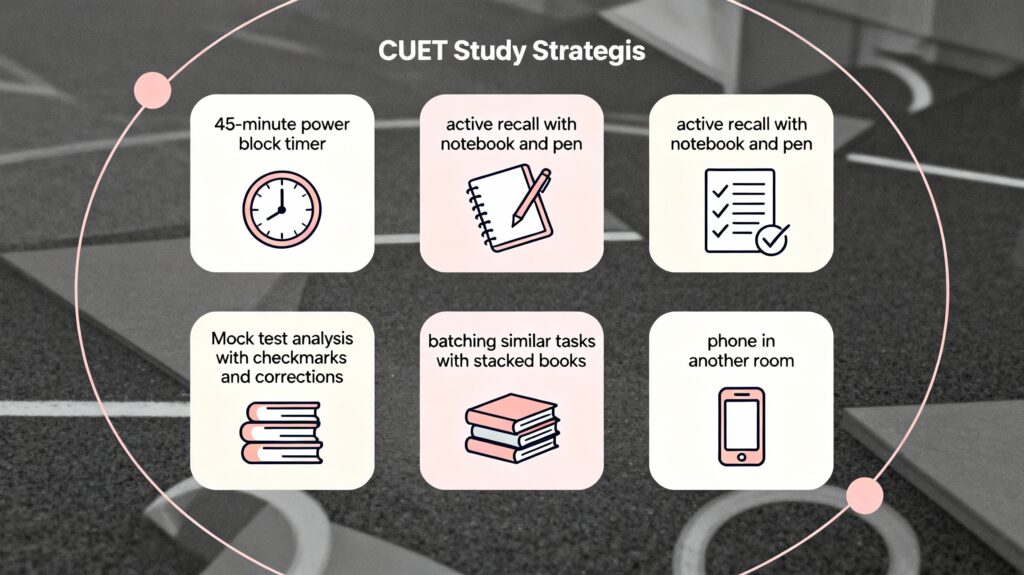
Hack #1: The 45-Minute Power Block
Ditch the 25-minute Pomodoro. It just doesn’t work for CUET level prep.
Instead, put in 45 minutes of real, solid focus. Phone in another room. No YouTube “research.” No checking WhatsApp “for one second.”
Then take a 10-minute break. Actually break. Walk around. Get water. Stretch.
In one 45-minute block you can
- Learn one concept deeply, OR
- Attempt 15-20 practice questions, OR
- Get through one topic’s theory and half the practice.
That’s more than most students do in three hours when they’re distracted.
Hack #2: Active Recall Rather than Re-Reading
Biggest time-waster I see: Students read a chapter. Then read it again. Then read it a third time.
Your brain doesn’t retain information by re-reading it; it retains information by retrieving it.
So, here’s what works:
Read a concept once. Understand it. Close the book. Write everything you remember without looking.
Then check your notes. What did you forget? What was wrong?
This takes 10 minutes and is worth 2 hours of re-reading.
Then, apply the spaced repetition rule:
- Review that concept after 1 day
- Review again in 3 days
- Review again in 7 days
- Review again after 15 days
Your CUETPLUS weekly planner should have “revision slots” inbuilt for just this.
Hack #3. The Mock Test Analysis Rule
I am seeing that students attempt a mock in 2 hours and immediately proceed to another. This is a huge mistake.
Actual rule: Devote 2x the test time to studying it.
2 hr mock = 4 hrs of analysis across the week.
For every incorrect response, ask:
- Did I not know the concept?
- Did I misread this question?
- Was I careless?
- Did I make a calculation mistake?
Find patterns. If you got 5 questions on data interpretation wrong, boom—that goes into next week’s planner as a focus area.
This is how you actually improve. Not by taking more mocks, by analyzing the ones you take.
Hack #4. Batch Similar Tasks
Don’t jump between reading comprehension then economics, then quant then current affairs.
Your brain hates task-switching. It is exhausting and slows you down.
Instead,
- Put all RC practice in one block.
- Put all economics learning in one block.
- Put all quant in one block.
Your brain gets into a rhythm. You’re faster, you’re more accurate, you waste less time getting focused.
Hack #5: Digital Minimalism during Study
Your phone is sabotage disguised as a tool.
Keep it in another room while studying. Not on silent. In another room.
If you have to have your phone around for resources, use an app blocker that really blocks Instagram, YouTube, WhatsApp while you study. There are free ones. Use them. Trust me, the 30 minutes you think you’re going to “quickly check” will be 2 hours.
Monthly CUET Study Planner: The Big Picture Strategy
Where weekly planners handle the execution, monthly planners handle strategy.
Your monthly planner answers:
- Which topics am I finishing this month?
- How many mocks am I taking?
- What’s my revision schedule?
- Am I on track or behind?
How to Structure a Monthly Plan
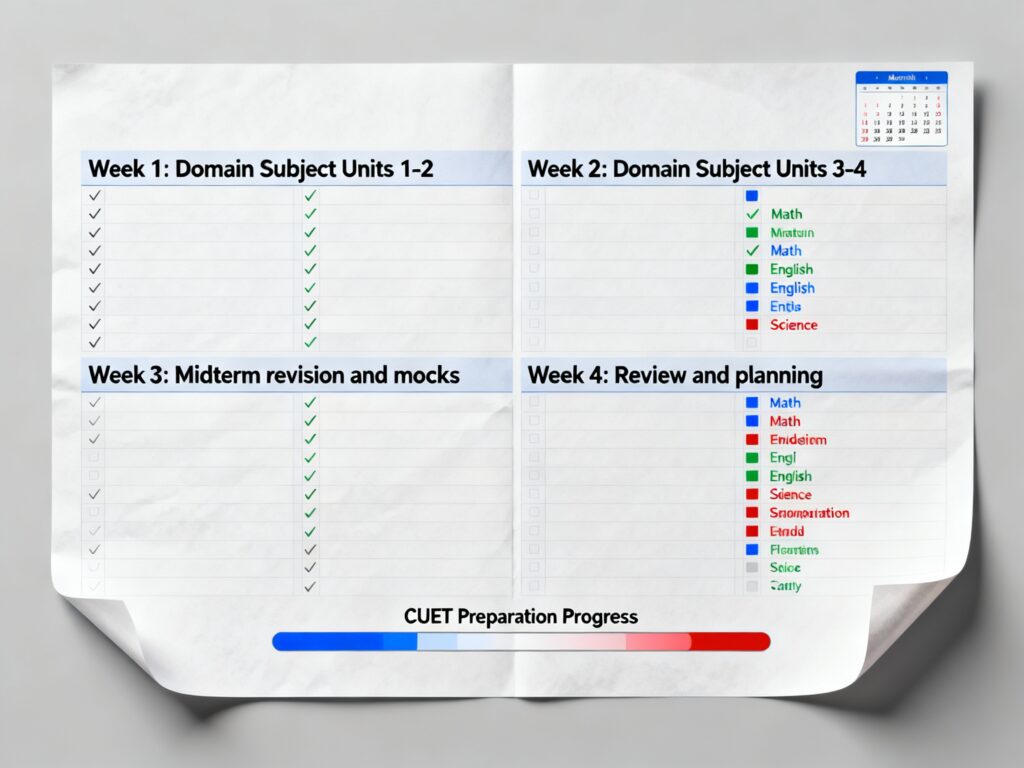
Divide your month into four weeks. For each week, write the
Week 1 Goals:
- Domain Subject 1: Complete units 1-2
- Domain Subject 2: Complete unit 1
- Finish vocabulary + reading practice
- General Test: Start reasoning (easy topics)
- Mocks: 1 sectional
Week 2 Targets:
- Domain Subject 1: Complete units 3-4
- Domain Subject 2: Complete units 2-3
- English: Grammar + more RC
- General Test: Continue reasoning + start quant
- Mocks: 1 sectional GT
And so forth,
Review at the end of the month:
- Did I complete what I had planned?
- What slowed me down?
- Am I on pace to complete the entire syllabus with time for revision?
This monthly perspective keeps you from getting lost in daily tasks and forgetting the bigger picture.
A month-on-month preparation blueprint for various courses and timelines can be viewed at the CUETPLUS Study Plan Hub.
Real Student Insights into What Actually Works: Humanized Expert Tips
I’ve talked to students who scored in the 95+ percentile, and I talked to students who struggled. The ones that succeeded shared a few things in common:
Insight #1: “Consistency beats intensity”.
One topper told me, “I didn’t study 10 hours a day. I studied 4-5 hours very consistently for eight months. That beat the guy who studied 12 hours a day for two months.”
Lesson: A sustainable routine you can actually maintain is more valuable than a heroic one that you cannot.
Insight #2: “Revision is not optional-it’s mandatory”
Another student said, “I realized in month three that I was forgetting chapters from month one. So I devoted every Friday to pure revision of the past week. That changed everything.”
The lesson: Your weekly planner must have at least 25% revision. Not an afterthought.
Insight #3: “Mocks are your honest feedback”
One such student who went from 87% to 98% percentile said, “I stopped caring about my mock scores. I started caring about my mock analysis. I treated each mock like a diagnostic test. It completely shifted my preparation.”
The lesson : You don’t study to take mocks. You take mocks to improve your studying.
Insight #4: “Your plan will fail sometimes, and that’s okay
Actual quote by a CUET topper: “I had this perfect planner. Life happened. I missed like three days the first month. I was so stressed. Then I realized-missing three days in a month is only 10% off schedule. Not a big deal. I adjusted and moved forward. That’s when I stopped stressing and started winning.”
Lesson to be learned: Perfect adherence is impossible. Adjustment is everything.
Common CUET Time Management Mistakes: Learn From Them
Mistake #1: Copying Someone Else’s Schedule Exactly
Your friend wakes up at 4 AM and studies for 3 hours before school. Good for them. For all you know, you despise the morning. Your schedule should fit your life, not someone else’s.
Take other people’s routines as inspirations, not rules.
Mistake #2: Planning Too Much (The Overwhelm Trap)
Writing 20 tasks for one day is setting yourself up for failure. You will have done 5, feel terrible, and give up.
Write 5 Do all 5. Feel great. Repeat.
Consistency trumps ambition any day.
Mistake #3: Not Considering Energy Levels
Some students try to force themselves to study at night when they’re naturally morning people. You fight your brain. You are inefficient. You are miserable.
Build your planner around when you’re naturally alert. It’s not laziness, it’s biology.
Mistake #4: Not leaving buffer time
If you plan every single minute from 5 AM to 11 PM, then you will burn out in two weeks.
Leave spaces open. Leave room for things to take longer than expected. Leave room to rest.
A good plan has space in it.
Mistake #5: Changing Your Plan Every Week
You make a plan on Monday; on Wednesday, you decide that it’s not working and change everything.
Give your plan at least two weeks before changing it. The consistency is what your brain needs. The plan needs a fair chance.
How to Actually Stick to Your CUET Study Planner: The Real Secret
All right, you have a planner. Great. But how do you really follow it, not ditch it after week two?
The Night Ritual- 10 Minutes
Every night spend 10 minutes:
- Review what you did today
- Check if you hit your targets
- Write down tomorrow’s top 3 priorities
- Adjust if something didn’t work.
The tiny ritual creates momentum. You begin each day with clarity instead of confusion.
The Weekly Review (20 minutes)
Sunday evening, take 20 minutes,
- Did you hit your targets this week? (Honestly)
- What went well?
- What didn’t work?
- What will you change next week?
- Next week’s plan:
This review is what transforms a plan from a piece of paper into a real system.
The Monthly Reflection – 30 minutes
Sit down once a month and ask yourself:
- Am I on pace with my syllabus?
- Which concepts am I having trouble grasping?
- Do I need to adjust my time allocation?
- Are my study hacks working?
This monthly check-in stops you from heading in the wrong direction without knowing it for weeks.
Join CUETPLUS WhatsApp alerts to get weekly strategy tips, mock test reminders, and planner updates sent to you. These are small nudges that keep you on track.