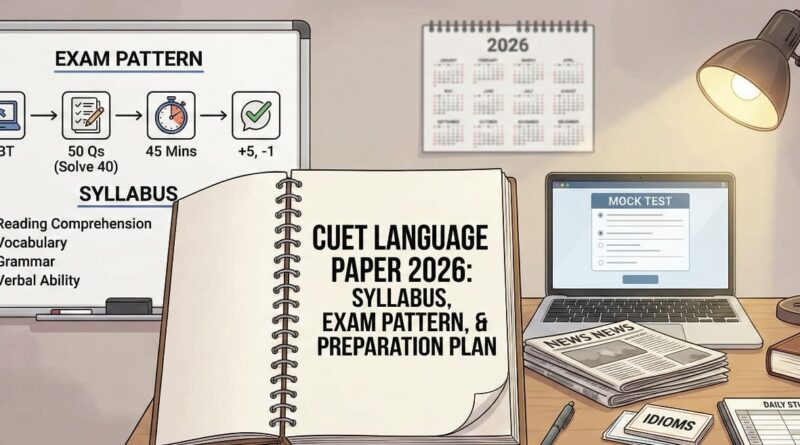
CUET Language Paper 2026: Syllabus, Exam Pattern, and Preparation Plan
Table of Contents
Introduction
The CUET Language Paper is an essential element of the Common University Entrance Test and represents a significant portion of many students’ scores, particularly those who are preparing for admission into a top-tier central university.
Whether you are studying for the CUET English exam or any other language exam, you need to be familiar with the exam syllabus, structure, and prep methods to do your best on the exam in 2026.
Students who have planned their CUET language paper preparation ahead of time, and who have prepared in an organised manner, tend to achieve markedly better results than other students. In this guide, we will give you a thorough overview of the CUET language syllabus, exam structure, and a step-by-step CUET preparation guide tailored to assist students who are applying to take Section I of the CUET test.
Understanding the CUET Language Exam (Section I)
The CUET language paper known as Section I of the CUET exam is geared to evaluate a student’s language knowledge, comprehension ability, vocabulary, and grammatical proficiency. For the majority of undergraduate programmes offered by central and state universities, it is a required part of the application process.
The CUET language test has a selection of 5 different languages which students may choose from, however, the CUET English exam is the most popular and has the broadest acceptance by universities.
The primary purpose of the cuet language paper is to measure:
- Reading and comprehension skills.
- Usage of language and accuracy of grammar.
- Depth of vocabulary and the context in which it is used
- The ability to interpret written information.
The focus of the paper is on understanding rather than rote memorization, so preparing smart will have a greater impact than studying excessive hours.
Why The CUET Language Paper Is Important For 2026 Aspirants
The score from CUET English exam is weighted heavily in the final merit list of many universities. Strong performance in Section I can:
- Increase overall CUET percentile.
- Help mitigate weaker domain subject areas.
- Create additional opportunities for selection in top colleges
While the cuet language syllabus continues to be driven by concepts, as the competition continues to increase every year, CUET Plus encourages students to treat the language paper as an additional opportunity for points rather than a minor section.
CUET Language Paper 2026 – The Exam Pattern
You should fully understand the structure of the exam before starting any preparation for it.
Basic Structure of the Exam
- Section: Section I (Language)
- Administration: Computer Based Test (CBT)
- Q&A: Multiple choice questions (MCQs)
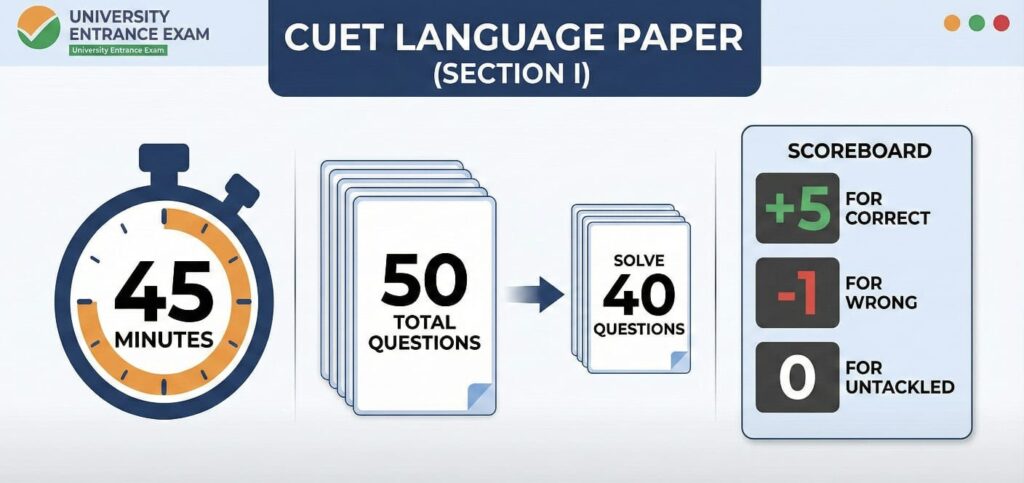
- Total Questions: 50
- No. Of Questions to Solve: 40
- Duration of the Exam: 45 Minutes
Marking Scheme
- +5 points for every right answer
- -1 point for every wrong answer
- No marks for questions untackled
The exam structure looks to reward faster responses while rewarding also accuracy when filling out the cuet language paper, so don’t guess when working out answers especially where you see vocabulary-related questions.
Detailed CUET Language Syllabus for 2026
The CUET Language Syllabus, unlike other literature-based curriculums, is focused on practical day-to-day language use and less on advanced literary concepts. This section contains several important topic areas regarding practical usage of language, which are clearly listed as follows.
Reading Comprehension
The highest weighted area of the CUET Language section; most valuable for your score.
This section consists of 1 or more passages that are either:
- Factual
- Narrative
- Literary/descriptive
You will be required to answer questions based on your understanding of the:
- Main Idea
- Inference and Conclusion
- Vocabulary Context
- Tone and Purpose
Your success with reading and use of material will help you become better readers, therefore increasing your performance on this area on the CUET English exam.
Vocabulary
The Vocabulary area provides questions related to your knowledge of words and your ability to understand them in context.
Types of questions you might see in this area are:
- Synonyms & Antonyms
- One-Word Substitutes
- Idioms and Phrases
- Contextual Uses of Words
The emphasis should be on developing an understanding of words through reading and using them, rather than through memorizing long lists of words.
Grammer and Language Usage
Unlike other exams, Grammar is not tested directly on the CUET Language Paper.
Important Grammar areas are:
- Tense
- Subject/Verb agreement
- Articles & Prepositions
- Active/Passive Voice
- Direct/Indirect Speech
Questions are usually error-based or sentence-improvement type.
Verbal Ability
In this assessment section, you will be evaluated on your logical thinking as well as your proficiency in using the correct flow of English in written communication at the level of this of an Chartered Board examination.
The sub-topics of English Ability cover:
- Sentence Rearrangement
- Para Jumbles
- Filling Blanks
- Sentence Completion
The questions on these topics are designed to evaluate both your clarity and your structure in thought and language.
CUET English Exam vs Other Language Test
The structure of the CUET English exam is the same as the structure for other languages, but the CUET English test also has a significantly larger applicant pool. However, scoring high marks in the CUET English test can be easier if the applicant understands the fundamentals.
Key Benefits of English:
- A broader range of universities that accept the English Language as a language of instruction
- A larger selection of study material available for English
- More easy access to computer-based practice tests and mock tests
CUET Plus recommends that students consider English as the language to take unless the student has a much greater proficiency in a different language.
Common Mistakes Students Make in CUET Language Paper Preparation
Many students under-estimate the difficulty of the CUET Language Paper and spend more time studying their domain subjects resulting in lower scores for Section I.
The most frequent errors students make when preparing for the Language Paper include:
- Failing to read practice materials
- Relying heavily on grammar rules
- Not completing mock tests
- Mismanaging time
By preventing these errors, students can increase their English exam score on the CUET by 20 to 30 points very easily.
CUET Language Paper Smart Preparation Guide 2026

A clear and realistic course of action for preparation is essential for success. CUET Plus provides this preparation plan step-by-step, as follows:
Step 1 – Build Good Reading Habits
Reading is the basis for the CUET Language Paper.
Daily reading suggestions:
- Read English newspapers.
- Read Editorial articles.
- Read short story and essay forms of literature.
The practice of reading improves comprehension, vocabulary, and speed, all of which are necessary for the CUET English Language Exam.
Step 2 – Gradually Strengthen Vocabulary
Do not cram all vocabulary in one day. It is recommended that you take the following approach:
- Learn 5 – 10 new words each day
- Use your vocabulary in sentences
- Revise each week.
The vocabulary questions on the CUET Language Exam are context based, not memory based.
Step 3 – Revise Basic Grammar
You do not have to know advanced grammar to do well on the CUET Language Exam; you only need to know and practice:
- Common Error Patterns
- Sentence Structure
- Usage Rules
You should practice grammar with multiple choice questions, as opposed to reading books.
Step 4: Solve Old Questions
When you are solving questions from former CUET language paper tests, it will give you an idea of the following:
- Trends in questions
- Difficulty of questions
- Pressure on time
Students enrolled in CUET Plus who practice solving past questions have shown more confidence when completing the actual test.
Step 5: Take Regular Mock Exams
It is impossible to ignore the importance of taking mock exams for the CUET English Test.
Mock exams will provide you with the following benefits:
- Management of time better
- Decrease test anxiety
- Improving accuracy
The best way to use mock exams is to begin with partial mocks and eventually transition into full mocks.
Time Management Strategy for Section I
Section I will only be given 45 minutes, and therefore, it is essential to manage your time well.
Suggested distribution of time among each sub-section of Section I:
- Reading Comprehension (RC): 18-20 minutes
- Vocabulary/Grammar (VG): 15 minutes
- Verbal Ability (VA): 10 minutes
To secure maximum points at the beginning of the examination attempt questions that are the easiest.
How CUET Plus Will Help You Ace CUET Language Paper
CUET Plus has a preparation programme designed exclusively for Section I. To support you, we will provide you with:
- Current coverage of cuet language syllabus
- Practice tests divided by subject
- Mock papers that reflect the difficulty level of the actual exam
- An assessment of your individual performance
Students taught at CUET Plus have shown improvement in both their speed of comprehension and the accuracy with which they answer the questions.
How to Analyze Your Performance in the CUET Language Paper
Performance analysis is an important step in your preparation for the CUET language paper. Although many students regularly practice their cuet language questions, it is common for them not to progress in their performance due to the lack of reviewing mistakes. For Section I candidates, performance analysis is the determining factor for gaining a high score or not.
It is essential to evaluate your performance after completing each practice or mock test by reviewing the following:
- Questions answered incorrectly
- Questions that you guessed on but answered correctly
- Questions that you could not attempt because of confusion
By reviewing these types of questions, you will have a better understanding of your weaknesses in the cuet language syllabus. For example, if you make a significant number of mistakes on inference reading questions, you need to improve your ability to identify passage tone and context, rather than simply increasing your reading speed.
Accuracy is More Important than Number of Attempts in the CUET English Exam
Accuracy in answering questions correctly in the CUET English exam is much more important than the number of questions you attempt. Random guessing can significantly reduce your overall score because of the negative marking associated with random guessing. The best strategy is to only attempt the questions that you are at least 70 – 80 % sure about answering correctly.
Most high scorers on the cuet Language Paper have used this strategy:
- Attempt to answer from your strong points first.
- Skip any question that you are confused by at first.
- Only return to these questions, after you have answered all of your strong points and you have enough time left to revisit them.
This approach ensures maximum score safety while maintaining speed. Remember, Section I rewards clarity and understanding, not risk-taking.
Role of Consistency in Language Preparation
Unlike domain subjects, language skills take time to develop. You will not improve by spending a full day studying the CUET Language syllabus and then taking off for a week. Instead, being consistent with your study will be much more successful than being intense.
The best daily schedule for language preparation is:
- 20-30 minutes of reading
- 15 minutes of vocabulary practice
- 10-15 MCQs related to the CUET Language paper
Small daily efforts will create good fundamentals over time and relieve some of the pressure of the CUET English exam.
Using Digital Resources Wisely for the CUET Language Paper
Tons of online resources exist for students to use, which can be confusing. So it is essential to select a few quality sources of studying that support the CUET Language syllabus. Students should avoid switching from book to book and source to source too often.
At CUET Plus, we recommend that students:
- Use only one primary series of mock tests.
- Have only one reference for grammar.
- Use only pre-selected reading passages to practice with.
Focussing on specific items will lead to continual improvement and better recall.
Final Thoughts

Your best chance of success on the CUET Language Paper will be to work hard and take the CUET Language Paper seriously by preparing wisely and frequently. By creating a plan of action for yourself, you can make Section I your most successful area on the CUET Language Paper.
Make sure you are fully aware of the CUET Language syllabus; practice consistently; and be honest with yourself when reviewing your progress. For example, if your goal is to take the CUET English exam by 2026, you have to be able to read and understand all types of writing and know how to use vocabulary to convey meaning.
It is imperative that all future CUET Language Paper examinees have mastered the content of the CUET English exam in order to gain admission into top universities. By seeking expert support from CUET Plus; consistently studying; and maintaining a positive attitude, you will find that the process of successfully completing the CUET Language Paper will be easy and enjoyable.
To reach your goals for becoming a successful CUET examinee, begin preparing today, continue to put forth the necessary effort, and develop your language skills until they have reached their highest potential.
Related Read: CUET for Non-Science Students (Humanities & Commerce)
If you are appearing for the CUET Language Paper as a student from Humanities or Commerce, it is important to align your Section I preparation with your overall CUET strategy. Many non-science students rely heavily on the CUET English exam to boost their total score, especially when domain subjects are theory-heavy.
To understand subject combinations, paper selection, and scoring strategies in detail, you can also explore our dedicated guide on “CUET for Non-Science Students: Best Strategy for Humanities & Commerce” This blog explains how arts and commerce aspirants can balance the cuet language paper, domain subjects, and general test to maximize university admission chances.
Reading both guides together will help you build a complete and practical CUET 2026 preparation plan.
FAQs: CUET Language Paper 2026
Q1. What is the CUET Language Paper?
The cuet language paper is Section I of the CUET exam that tests reading comprehension, vocabulary, grammar, and verbal ability.
Q2. Is the CUET English exam compulsory for all students?
The CUET English exam is required for most undergraduate courses, but students may choose another language if allowed by their target universities.
Q3. What topics are covered in the CUET language syllabus?
The cuet language syllabus includes reading comprehension, vocabulary, grammar usage, sentence structure, and verbal ability.
Q4. How many questions are there in the CUET Language Paper?
There are 50 questions, out of which students must attempt 40 within 45 minutes.
Q5. Is there negative marking in the CUET English exam?
Yes, one mark is deducted for every incorrect answer in the cuet language paper.